
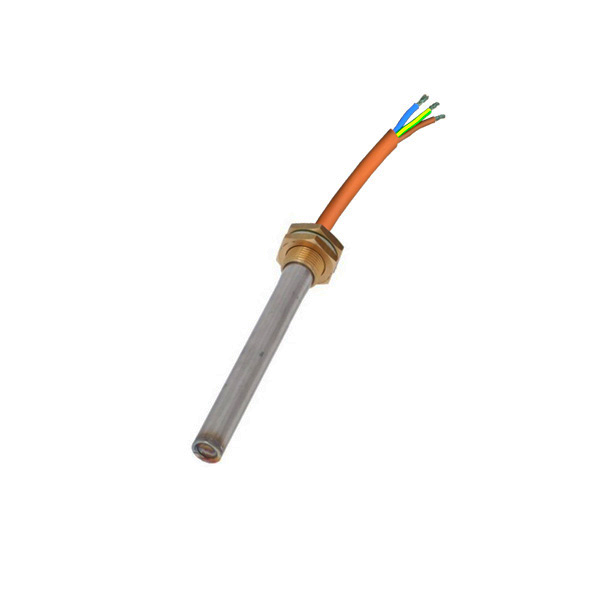
Tube Material: 310S
Diameter: 12mm
Length: 100mm to 700mm
Temperature: -30°C ~ +200°C
${Details}
Product Overview
Our Self-Regulating PTC Cartridge Heaters represent a significant advancement in electric heating technology. Unlike traditional resistance heaters that require external thermostats to prevent overheating, these heaters utilize Positive Temperature Coefficient (PTC) ceramic elements.
This intelligent material automatically adjusts its resistance as the temperature rises. As the heater warms up, its power output decreases, naturally stabilizing at a preset temperature. This unique characteristic makes them inherently safe, energy-efficient, and virtually burnout-proof, making them the ideal choice for applications where reliability is critical and maintenance is difficult.
Key Features & Benefits
Intrinsic Safety (Self-Limiting): The PTC element limits its own maximum surface temperature. Even if the thermostat fails or the heater is dry-fired, it will not overheat or melt the surrounding material.
Energy Efficiency: The heater consumes maximum power only when cold. As it approaches the target temperature, power consumption drops significantly, reducing energy waste without complex control circuits.
Long Service Life: Because the element does not run at maximum temperature continuously, thermal stress is minimized, resulting in a lifespan significantly longer than traditional wire-wound cartridge heaters.
Wide Voltage Compatibility: PTC heaters are less sensitive to voltage fluctuations. A single heater design can often operate effectively across a range of voltages (e.g., 100V–240V) without damage.
Vibration Resistant: The solid-state ceramic construction makes these heaters highly resistant to vibration and shock, perfect for mobile or industrial machinery.
Applications
PTC Cartridge Heaters are widely used in scenarios requiring safe, maintenance-free heating:
Application Why Use PTC Heaters?
Hot Melt Adhesive Systems Prevents charring of glue by strictly limiting max temperature.
Medical & Lab Equipment Safe, stable heating for sterilizers and analyzers without risk of runaway temps.
3D Printers Reliable bed and hotend heating with built-in thermal safety.
Battery Heating Safe warming of Li-ion batteries in cold environments (EVs/Storage).
Food Packaging Sealing jaws that need consistent, safe heat without burning packaging film.
Instrumentation Keeping sensors and gauges warm in outdoor/cold environments.
Technical Specifications
Parameter Specification
Heating Element PTC Ceramic (Positive Temperature Coefficient)
Sheath Material Stainless Steel (SS304 / SS316) / Aluminum / Copper
Self-Limiting Temp 60°C to 250°C (Customizable Curie Point)
Voltage Range 12V – 240V (AC/DC)
Power Density 1 W/cm² – 15 W/cm² (Auto-adjusting)
Diameter 6mm – 20mm (Standard sizes)
Length 20mm – 500mm (Customizable)
Insulation Resistance > 100 MΩ @ 500V DC
How It Works: The PTC Effect
Cold Start: When power is first applied, the PTC ceramic has low electrical resistance, allowing a high current to flow and generating heat rapidly.
Temperature Rise: As the heater warms up, the resistance of the ceramic begins to increase exponentially.
Equilibrium: At a specific temperature (the Curie point), the resistance becomes very high, reducing the current to a trickle. The heater stabilizes at this temperature, maintaining heat without consuming full power.
Comparison: PTC vs. Traditional Wire-Wound Heaters
Feature PTC Cartridge Heater Traditional Wire-Wound Heater
Temperature Control Self-Regulating (Intrinsic) Requires External Thermostat/Controller
Safety High (Will not overheat/burn out) Moderate (Risk of burnout if dry-fired)
Energy Use Efficient (Power drops as T rises) Constant (Full power until switched off)
Lifespan Very Long Limited by element oxidation
Cost Higher Initial Cost Lower Initial Cost


